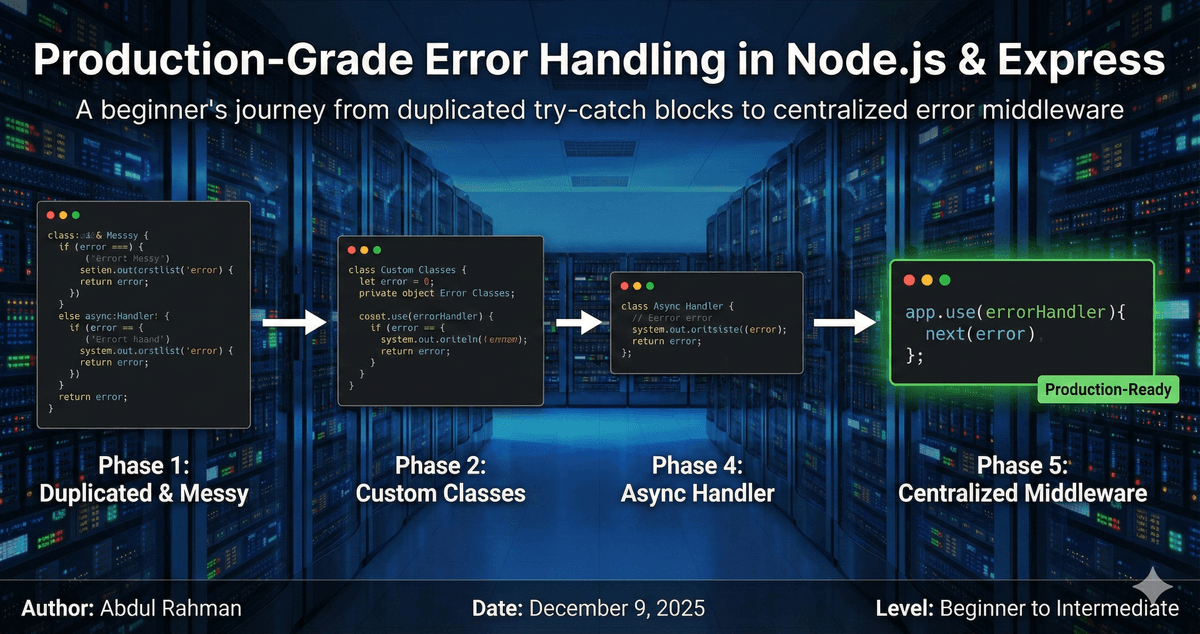
Production-Grade Error Handling in Node.js & Express
A beginner's journey from duplicated try-catch blocks to centralized error middleware
The Problem {#the-problem}
When I started building Express backends, I was confused about:
Phase 1: Inline Error Responses {#phase-1}
What I Initially Wrote
// ❌ PHASE 1: No error handling for async operations
export const register = async (req, res) => {
  const { email, password } = req.body;

  if (!email) {
    res.status(400).json({ error: "Email required" });
    return;
  }

  if (!password) {
    res.status(400).json({ error: "Password required" });
    return;
  }

  // ⚠️ This WILL crash if database is down!
  const user = await prisma.user.create({ data: { email, password } });
  res.status(201).json({ user });
};
Problems
Lesson Learned: We need try-catch for async operations!
Phase 2: Adding Try-Catch {#phase-2}
The "Fix"
// ✅ Better: Won't crash, but duplicated everywhere
export const register = async (req, res) => {
  try {
    const { email, password } = req.body;

    if (!email) {
      res.status(400).json({ error: "Email required" });
      return;
    }

    const user = await prisma.user.create({ data: { email, password } });
    res.status(201).json({ user });
  } catch (error) {
    console.error(error);
    res.status(500).json({ error: "Registration failed" });
  }
};

// Repeat this pattern 50+ times... 😫
New Problems
Lesson Learned: We need to distinguish between error types!
Phase 3: Throwing Errors {#phase-3}
Throw Instead of Return
// 🔄 BETTER: Throw errors, catch handles responses
export const register = async (req, res) => {
  try {
    if (!email) throw new Error("Email required");
    if (!password) throw new Error("Password required");

    const user = await prisma.user.create({ data: { email, password } });
    res.status(201).json({ user });
  } catch (error) {
    console.error(error);
    res.status(400).json({ error: error.message });
  }
};
Still Have Problems
Lesson Learned: We need custom error classes with status codes!
Phase 4: Custom Error Classes {#phase-4}
Create Error Classes
// src/utils/errors.ts
class AppError extends Error {
  statusCode: number;

  constructor(statusCode: number, message: string) {
    super(message);
    this.statusCode = statusCode;
  }
}

class ValidationError extends AppError {
  constructor(message: string) {
    super(400, message); // Always 400
  }
}

class UnauthorizedError extends AppError {
  constructor(message: string) {
    super(401, message); // Always 401
  }
}

class NotFoundError extends AppError {
  constructor(message: string) {
    super(404, message); // Always 404
  }
}

class ConflictError extends AppError {
  constructor(message: string) {
    super(409, message); // Always 409
  }
}
Use in Controllers
// 🔄 BETTER: Different error types with correct status codes
export const register = async (req, res) => {
  try {
    if (!email) throw new ValidationError("Email required"); // 400

    const existing = await prisma.user.findUnique({ where: { email } });
    if (existing) throw new ConflictError("Email already registered"); // 409

    const user = await prisma.user.create({ data: { email, password } });
    res.status(201).json({ user });
  } catch (error) {
    console.error(error);
    if (error instanceof AppError) {
      res.status(error.statusCode).json({ error: error.message });
    } else {
      res.status(500).json({ error: "Server error" });
    }
  }
};
Remaining Problem
Lesson Learned: We need to centralize error handling!
Phase 5: Error Middleware {#phase-5}
Understanding Middleware
Middleware is a function Express calls in sequence:
Request → Middleware 1 → Middleware 2 → Controller → Response
The Magic: Express identifies error handlers by counting parameters!
// Normal middleware (3 parameters)
app.use((req, res, next) => {
  console.log("Normal middleware");
  next();
});

// Error middleware (4 parameters) ← The magic!
app.use((err, req, res, next) => {
  // ^^^ Extra parameter makes it an error handler!
  console.log("Error middleware");
  res.status(500).json({ error: err.message });
});
When you call next(error), Express skips all normal middleware and jumps to the first function with 4 parameters!
Create Error Middleware
// src/middlewares/error.middleware.ts
export const errorHandler = (
  err: Error,      // ← 1st parameter
  req: Request,    // ← 2nd parameter
  res: Response,   // ← 3rd parameter
  next: NextFunction // ← 4th parameter (makes it error handler!)
): void => {
  console.error("Error:", err);

  // Check if it's our custom error
  if (err instanceof AppError) {
    res.status(err.statusCode).json({
      success: false,
      message: err.message,
    });
    return;
  }

  // Unknown error - default to 500
  res.status(500).json({
    success: false,
    message: "Internal server error",
  });
};
Register in Server (MUST BE LAST!)
// src/server.ts
const app = express();

// Normal middleware
app.use(express.json());

// Routes
app.use("/api/auth", authRoutes);

// ✅ Error handler MUST be registered LAST!
app.use(errorHandler);

app.listen(4000);
Update Controllers
// ✅ MUCH BETTER: Pass errors to middleware
export const register = async (req, res, next) => {
  try {
    if (!email) throw new ValidationError("Email required");

    const existing = await prisma.user.findUnique({ where: { email } });
    if (existing) throw new ConflictError("Email already registered");

    const user = await prisma.user.create({ data: { email, password } });
    res.status(201).json({ user });
  } catch (error) {
    next(error); // ← Pass to middleware!
  }
};
Visual Flow
Controller throws error
         ↓
Catch block: next(error)
         ↓
Express skips normal middleware
         ↓
Error middleware runs
         ↓
Sends response to client
Remaining Problem
Lesson Learned: Can we eliminate try-catch entirely?
Phase 6: AsyncHandler - The Final Solution! {#phase-6}
The Problem
// Async function returns a Promise
export const register = async (req, res) => {
  throw new Error("Oops"); // Creates rejected Promise
};

// Express doesn't catch Promise rejections automatically!
// Result: Unhandled Promise Rejection 💥
The Solution: AsyncHandler Wrapper
// src/utils/asyncHandler.ts
export const asyncHandler = (
  fn: (req: Request, res: Response, next: NextFunction) => Promise<void>
) => {
  return (req: Request, res: Response, next: NextFunction) => {
    Promise.resolve(fn(req, res, next)).catch(next);
  };
};
How It Works
Think of it as automatic try-catch:
// Without asyncHandler - manual try-catch
export const register = async (req, res, next) => {
  try {
    const user = await prisma.user.create({ data: req.body });
    res.json({ user });
  } catch (error) {
    next(error);
  }
};

// With asyncHandler - automatic try-catch
export const register = asyncHandler(async (req, res) => {
  const user = await prisma.user.create({ data: req.body });
  res.json({ user });
  // asyncHandler automatically does .catch(next) for us!
});
Final Controllers - Clean & Beautiful!
// ✅ PERFECT: No try-catch needed!
export const register = asyncHandler(async (req: Request, res: Response) => {
  const { email, password } = req.body;

  if (!email) throw new ValidationError("Email required");

  const existing = await prisma.user.findUnique({ where: { email } });
  if (existing) throw new ConflictError("Email already registered");

  const user = await prisma.user.create({ data: { email, password } });

  res.status(201).json({
    success: true,
    data: { user },
  });
});

export const login = asyncHandler(async (req: Request, res: Response) => {
  const { email, password } = req.body;

  const user = await prisma.user.findUnique({ where: { email } });
  if (!user) throw new UnauthorizedError("Invalid credentials");

  res.json({
    success: true,
    data: { user },
  });
});
Common Pitfalls {#pitfalls}
Pitfall 1: Wrong Number of Parameters
// ❌ WRONG: Only 2 parameters
app.use((err, res) => {
  res.status(500).json({ error: err.message });
});

// ✅ CORRECT: MUST have 4 parameters
app.use((err, req, res, next) => {
  res.status(500).json({ error: err.message });
});
Pitfall 2: Error Handler in Wrong Position
// ❌ WRONG: Before routes
app.use(errorHandler);
app.use("/api/auth", authRoutes);

// ✅ CORRECT: After routes
app.use("/api/auth", authRoutes);
app.use(errorHandler);
Pitfall 3: Forgetting next() Parameter
// ❌ WRONG: No next parameter
export const register = async (req, res) => {
  try {
    // ...
  } catch (error) {
    // Can't pass to middleware!
  }
};

// ✅ CORRECT: Include next
export const register = async (req, res, next) => {
  try {
    // ...
  } catch (error) {
    next(error);
  }
};
Complete Example {#complete}
Project Structure
src/
├── controllers/
│   └── auth.controller.ts
├── middlewares/
│   └── error.middleware.ts
├── routes/
│   └── auth.route.ts
├── utils/
│   ├── errors.ts
│   └── asyncHandler.ts
└── server.ts
1. Error Classes
// src/utils/errors.ts
export class AppError extends Error {
  constructor(
    public statusCode: number,
    public message: string
  ) {
    super(message);
  }
}

export class ValidationError extends AppError {
  constructor(message: string) { super(400, message); }
}

export class UnauthorizedError extends AppError {
  constructor(message: string = "Unauthorized") { super(401, message); }
}

export class NotFoundError extends AppError {
  constructor(message: string = "Not found") { super(404, message); }
}

export class ConflictError extends AppError {
  constructor(message: string = "Already exists") { super(409, message); }
}
2. AsyncHandler
// src/utils/asyncHandler.ts
import { Request, Response, NextFunction } from "express";

export const asyncHandler = (
  fn: (req: Request, res: Response, next: NextFunction) => Promise<void>
) => {
  return (req: Request, res: Response, next: NextFunction) => {
    Promise.resolve(fn(req, res, next)).catch(next);
  };
};
3. Error Middleware
// src/middlewares/error.middleware.ts
import { Request, Response, NextFunction } from "express";
import { AppError } from "../utils/errors.js";

export const errorHandler = (
  err: Error,
  req: Request,
  res: Response,
  next: NextFunction
): void => {
  console.error("Error:", err);

  if (err instanceof AppError) {
    res.status(err.statusCode).json({
      success: false,
      message: err.message,
    });
    return;
  }

  res.status(500).json({
    success: false,
    message: "Internal server error",
  });
};
4. Controller
// src/controllers/auth.controller.ts
import { Request, Response } from "express";
import { asyncHandler } from "../utils/asyncHandler.js";
import { ValidationError, UnauthorizedError, ConflictError } from "../utils/errors.js";
import { prisma } from "../lib/prisma.js";

export const register = asyncHandler(async (req: Request, res: Response) => {
  const { email, password, name } = req.body;

  if (!email) throw new ValidationError("Email required");
  if (!password) throw new ValidationError("Password required");

  const existingUser = await prisma.user.findUnique({ where: { email } });
  if (existingUser) throw new ConflictError("Email already registered");

  const user = await prisma.user.create({
    data: { email, password, name },
    select: { id: true, email: true, name: true },
  });

  res.status(201).json({
    success: true,
    data: { user },
  });
});

export const login = asyncHandler(async (req: Request, res: Response) => {
  const { email, password } = req.body;

  if (!email) throw new ValidationError("Email required");
  if (!password) throw new ValidationError("Password required");

  const user = await prisma.user.findUnique({ where: { email } });
  if (!user) throw new UnauthorizedError("Invalid credentials");

  res.status(200).json({
    success: true,
    data: { user },
  });
});
5. Server Setup
// src/server.ts
import express from "express";
import { authRoutes } from "./routes/index.js";
import { errorHandler } from "./middlewares/error.middleware.js";

const app = express();
const PORT = 4000;

// Middleware
app.use(express.json());

// Routes
app.use("/api/auth", authRoutes);

// 404 Handler
app.use("*", (req, res) => {
  res.status(404).json({
    success: false,
    message: `Route ${req.originalUrl} not found`,
  });
});

// Error Handler (MUST BE LAST)
app.use(errorHandler);

app.listen(PORT, () => {
  console.log(`🚀 Server running on http://localhost:${PORT}`);
});
Summary: The Evolution
The Journey
Phase 1: Inline responses → App crashes
Phase 2: Try-catch everywhere → Duplicated 50+ times
Phase 3: Throw in try → Still duplicated catch
Phase 4: Custom errors → Better, but still duplicated
Phase 5: Error middleware → Centralized handling
Phase 6: AsyncHandler → Perfect! Clean & maintainable
Before vs After
// ❌ BEFORE: 15 lines per controller
export const register = async (req, res) => {
  try {
    if (!email) {
      res.status(400).json({ error: "Email required" });
      return;
    }
    const user = await prisma.user.create({ data: { email, password } });
    res.status(201).json({ user });
  } catch (error) {
    console.error(error);
    res.status(500).json({ error: "Registration failed" });
  }
};

// ✅ AFTER: 8 lines per controller
export const register = asyncHandler(async (req, res) => {
  if (!email) throw new ValidationError("Email required");
  const user = await prisma.user.create({ data: { email, password } });
  res.status(201).json({ user });
});
47% less code, infinitely more maintainable! 🎉
Key Takeaways
✅ Custom error classes provide consistent status codes
✅ Error middleware centralizes error handling logic
✅ AsyncHandler eliminates repetitive try-catch blocks
✅ Clean controllers focus only on business logic
✅ Maintainable codebase with consistent error responses
Happy coding! 🚀